
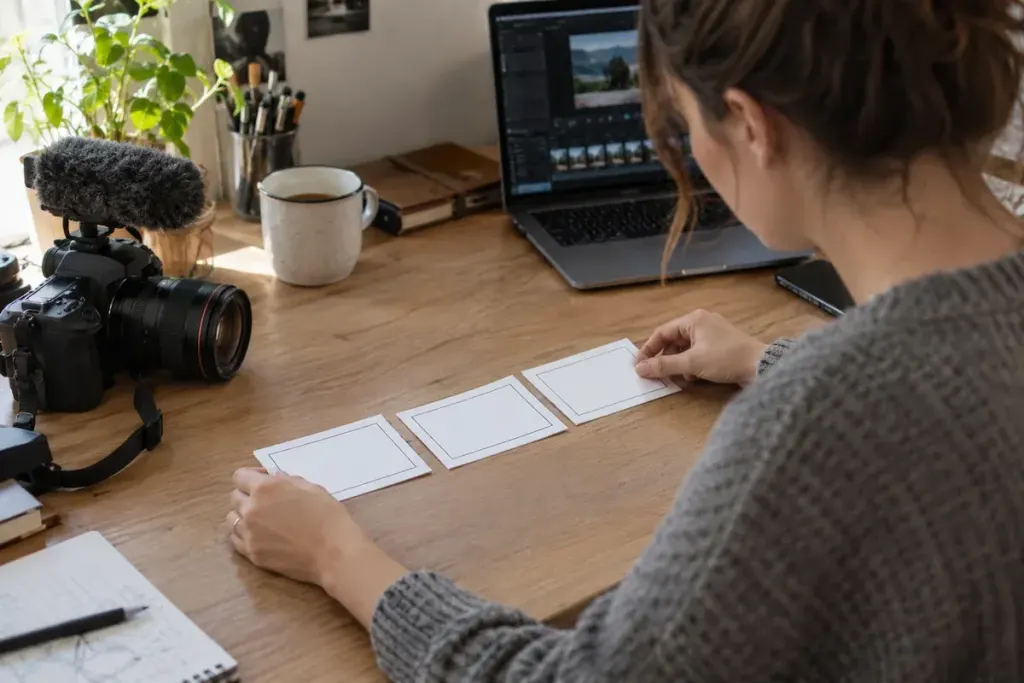
A video opening does two jobs: it tells the viewer what they have found and gives them a reason to stay. It does not need to be loud. For a useful tutorial, showing the problem clearly may be more compelling than a dramatic claim about changing someone’s life.
Before filming, write the video’s promise in one sentence. An example is: “By the end, you will know how to organise a small desk without buying new furniture.” If the script cannot deliver that promise, narrow it now.
Try three routes into the same idea
A problem-led opening names a recognisable frustration: “There is room for the laptop, but nowhere to put the notebook.” A result-led opening shows the organised desk and explains what changed. A question-led opening asks the viewer to notice a detail: “Which of these three objects actually needs to stay within reach?”
These are illustrative scripts, not formulas for guaranteed views. Keep the underlying topic and promised result the same while comparing them. Otherwise you are choosing between different videos rather than different openings.
Read each version aloud
Mark the moment when a new viewer would understand the subject. Cut background information that arrives before it is needed. A long account of why you decided to make the video may be meaningful to you but delay the part the viewer clicked to see.
Check the title and thumbnail alongside the opening. If they promise a practical demonstration, deliver one promptly. If the opening quietly changes the subject, a clever first sentence will not solve the mismatch.
Test comprehension before performance
Show the options to a few people who resemble the intended audience. Ask what they expect to learn, not merely which opening they like. Their answers can reveal an unclear promise even when the wording sounds polished.
After publication, use evidence cautiously. YouTube’s audience-retention guidance explains how the introduction and other moments appear in video-level analytics. A drop can suggest a question to investigate; it does not prove that one sentence caused viewers to leave.
Compare similar videos and keep notes on other differences, such as topic, traffic source and length. Avoid treating a small audience as a decisive experiment. Your next edit should respond to a plausible problem: a delayed demonstration, unnecessary repetition or a title that invited the wrong expectation.
Choose the opening that gives an honest, specific reason to continue. Then make the rest of the video earn it.
Another practical question: Cleaner Voice Recordings Start with the Room, Not Another Microphone.